Parenting a Neurodivergent Child: A Journey of Trust, Patience, and Mercy
A Day with My Child: A Trust from Allah
I used to ask those questions. Why did Allah give me a child with special needs? Will I be able to manage? Did I do something wrong? Is this a punishment?
I remember sitting quietly after a long day, my child finally asleep, feeling that strange mix of love and exhaustion and confusion, the kind that settles into your chest and stays there. The world around me seemed to move so easily for other families, while every small task for us required planning, patience, and sometimes tears I didn’t even know were coming until they were already falling.
But over time, something shifted. Not my child. Me.
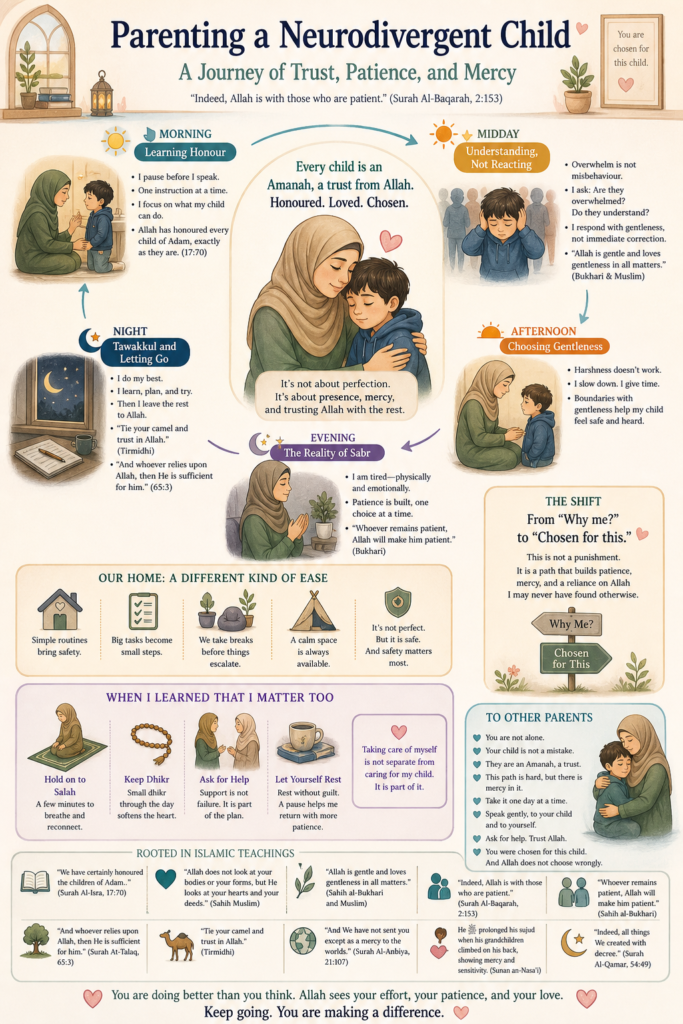
Morning: Learning Honour
Our mornings don’t begin with ease. They often begin with resistance. Getting dressed, brushing teeth, transitions that feel simple to most but genuinely overwhelming for my child. There was a time I would say, “Why are you making this so difficult?” I’m not proud of that.
Now I try to pause first.
Allah says He has honoured every child of Adam, and that includes my child, exactly as they are. Not when they behave a certain way. Not after they improve. Right now, in this moment, they are honoured. So, I try to speak with that in mind. I lower my voice. I give one instruction instead of five. I look for what they can do, not just what they are struggling with. And I remind myself that Allah is not measuring my child against some standard of typical. He looks at hearts.
Midday: Understanding, Not Reacting
By midday, the world gets louder. A crowded place, too many sounds, too many people talking at once, and suddenly my child shuts down or lashes out. What someone else might call misbehaviour is, for us, a signal that something is too much.
I used to correct immediately. Now I have learned to ask myself first: are they overwhelmed? Do they actually understand what I am asking of them?
The Prophet ﷺ showed gentleness even when others around him reacted with frustration. I try to hold onto that. Sometimes responding gently means stepping away from the situation entirely. Sometimes it means saying nothing at all, just being present. Because not every difficult moment needs correction. Some moments just need someone to understand.
Afternoon: Choosing Gentleness
There are still hard moments. I won’t pretend otherwise. The repeated instructions. The emotional outbursts that seem to come from nowhere. The exhaustion that builds so quietly you don’t notice it until you are already at your limit.
What I have learned, mostly the hard way, is that harshness doesn’t work. Not for my child, and honestly, not for me either. When I rush, when I raise my voice, when I pile on instructions, everything falls apart faster. When I soften, when I slow down and give things time to settle, something shifts. Gentleness is not the absence of boundaries. It is how I hold them, calmly, one step at a time, with enough space for my child to actually hear me.
Evening: The Reality of Sabr
By evening, I am tired in a way that is hard to explain. Not just physically but emotionally tired. The kind of tired that comes from repeating the same thing, managing the same reactions, explaining to the world around you what it still doesn’t quite understand.
But I keep coming back to this: Allah is with those who are patient. And patience, I have realised, is not something I either have or don’t have. It is something Allah builds in me, every time I choose not to react, every time I pause before I speak, every time I make duʿā in the middle of a hard moment instead of giving up. It is built slowly, quietly, in the ordinary moments nobody else sees.
Night: Tawakkul and Letting Go
The worries always come back at night. What will their future look like? Will they be okay? Am I doing enough, or have I been getting it wrong all along?
This is where I have to remind myself of something I keep forgetting and keep relearning: I am responsible for effort, not outcomes. My job is to learn about my child, work with their teachers, create routines that help them feel safe, and try new strategies when old ones stop working. And then, genuinely and not just as something I say, leave the rest to Allah. Tie your camel and trust. It sounds simple. It isn’t. But it is the only thing that actually brings peace.
Our Home: A Different Kind of Ease
Our home doesn’t look like other homes, and I have made peace with that. It is quieter in some ways, more structured in others. We have simple routines because surprise is hard. We break big tasks into small steps because overwhelming my child helps no one. We take breaks before things escalate, and there is always a calm space when the world gets to be too much.
It is not perfect. But it is safe. And I have come to believe that safety matters far more than perfection ever could.
The Shift: From “Why Me?” to “Chosen for This”
I don’t ask “why” anymore, or at least not the way I used to.
What I feel now is different. Allah trusted me with this child. This is not a punishment. It is not a sign of His anger or a reflection of my failures. It is a path, one I didn’t choose and wouldn’t have chosen, but one that has taught me patience I didn’t know I had, mercy I didn’t know I needed, and a reliance on Allah that I am not sure I would have found any other way.
When I Learned That I Matter Too
There came a point when I couldn’t ignore it anymore. I was running on empty.
Every bit of energy was going outward, into my child, into each day, into managing and planning and holding things together. And somewhere in all of that, I had stopped taking care of myself. I noticed it in the sharpness that crept into my voice, in how quickly I reached my limit, in how heavy everything felt.
That’s when I understood it properly: I cannot pour into my child from an empty place.
Even the Prophet ﷺ, carrying responsibilities far beyond anything I will ever face, took time to rest, to reflect, to reconnect with Allah. I had to stop pretending I was exempt from that need.
So now I hold onto my salah, not just as an obligation but as a few minutes where I can genuinely breathe. I keep small dhikr through the day, sometimes during chores, sometimes in the middle of a moment that is about to go sideways. It doesn’t fix everything but it softens something in me. I have also slowly learned to ask for help, from family or a trusted friend, which I resisted for a long time as though needing support was a kind of failure.
And the hardest thing: I let myself rest without turning it into guilt. Not every pause is wasted time. Sometimes stepping back is the very thing that lets me return with more patience, more steadiness, and more of myself to give.
Taking care of myself is not separate from caring for my child. It is part of it.
To Other Parents
If you are somewhere at the beginning of this, feeling overwhelmed and questioning everything, please know you are not alone.
Your child is not a mistake. They are not less. They are not the result of your sins or a sign of Allah’s displeasure. They are an Amanah, a trust, and the fact that you are here, reading this, trying to understand, already says something about how seriously you are taking that trust.
Yes, this path is hard. I won’t soften that. But there is something in it, a closeness to Allah, a depth of mercy you develop almost without realising it, that I genuinely would not trade.
Take it one day at a time. Speak gently, to your child and to yourself. Ask for help when you need it. Trust Allah with the parts you cannot control.
And when the day feels heavier than you can carry, hold onto this: you were chosen for this child. And Allah does not choose wrongly.
References:
“We have certainly honoured the children of Adam…” (Surah Al-Isra, 17:70)
The Prophet ﷺ said: “Allah does not look at your bodies or your forms, but He looks at your hearts and your deeds.” (Sahih Muslim)
The Prophet ﷺ said: “Allah is gentle and loves gentleness in all matters.” (Sahih al-Bukhari and Muslim)
“Indeed, Allah is with those who are patient.” (Surah Al-Baqarah, 2:153)
The Prophet ﷺ said: “Whoever remains patient, Allah will make him patient.” (Sahih al-Bukhari)
“And whoever relies upon Allah, then He is sufficient for him.” (Surah At-Talaq, 65:3)
The Prophet ﷺ taught: “Tie your camel and trust in Allah.” (Tirmidhi)
Allah describes the Prophet ﷺ: “And We have not sent you except as a mercy to the worlds.” (Surah Al-Anbiya, 21:107)
He ﷺ prolonged his sujud when his grandchildren climbed on his back, showing sensitivity to their needs rather than prioritising his own comfort. (Sunan an-Nasa’i)
“Indeed, all things We created with decree.” (Surah Al-Qamar, 54:49)