What Is Leadership, really?
We often hear the word “leadership” thrown around in schools, corporate workshops, and motivational talks. But if we pause and ask what it means, we quickly realize that most of what is marketed to us as “leadership” is, at its core, something quite shallow.
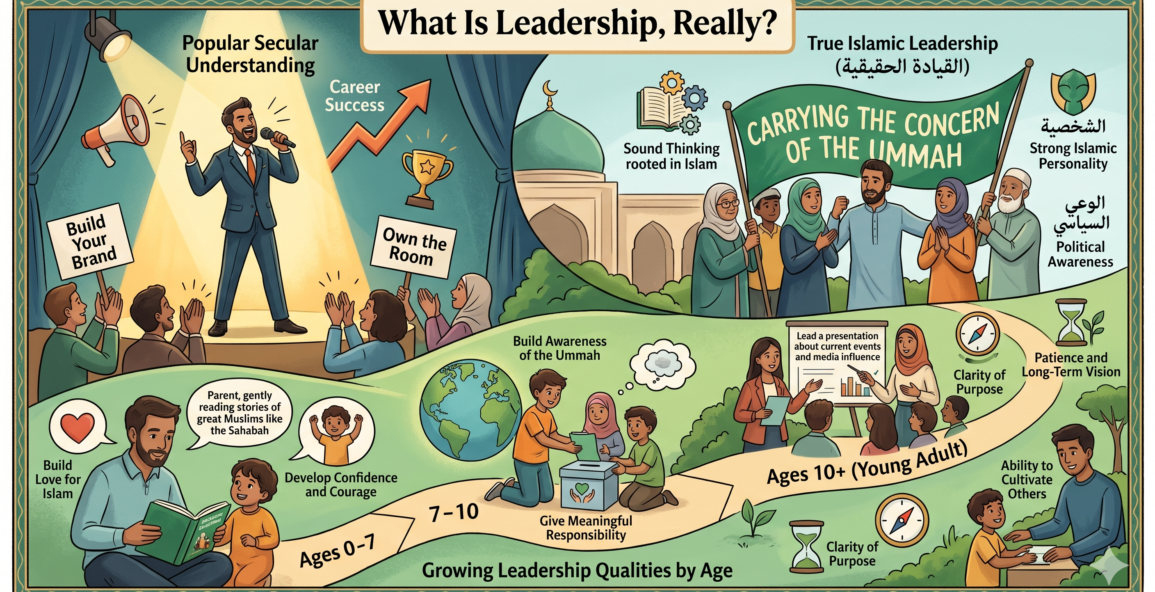
The popular secular understanding of leadership tends to focus on personality. It prizes charisma, confidence, public speaking, networking skills, and the ability to manage people and projects. Leadership development programs teach children to speak loudly, “own the room,” build their personal brand, and compete to get ahead. At the centre of this model is the individual, their success, their recognition, their career. Even when words like “servant leadership” or “social impact” are used, the underlying measure is often personal achievement and influence.
(meaning of these two highlighted terms and there secular roots are given in the end of the document)
A Deeper Understanding of Leadership (القيادة الحقيقية)
In the Islamic intellectual tradition, leadership is not about personality or popularity. It is about carrying a responsibility; for your family, your community, and the Ummah at large. A true leader, in this tradition, is someone who combines:
- Sound, clear thinking rooted in Islam
- A strong Islamic personality (الشخصية الإسلامية)
- Political and social awareness (الوعي السياسي)
- Deep concern for the Ummah (حمل همّ الأمة)
- Courage, patience, and emotional discipline
- The ability to understand reality and work to change it
This is a comprehensive vision. It means that leadership is not a skill you add on top of an otherwise secular life. It grows from the inside, from how a person thinks, what they value, what they are willing to sacrifice, and how deeply they understand the world around them.
A leader in this sense does not follow public opinion. They do not change their position based on who is watching. They feel the suffering of the Ummah as a personal weight, and they act, not for recognition, but out of responsibility to Allah.
This is the kind of person we should be trying to raise.
The Ten Core Qualities
Before looking at how to develop these qualities by age, it is worth naming them clearly, so parents understand what the goal is.
-
Correct Intellectual Foundation (الفكر الصحيح)
A leader thinks clearly and deeply. They understand Islam not just as a set of rituals, but as a complete way of seeing life, society, and civilization. They can tell the difference between truth and falsehood, between surface-level events and their underlying causes.
-
Strong Islamic Personality (الشخصية الإسلامية)
This means the mind thinks according to Islam, and the emotions are governed by Islamic values. Sincerity, moral discipline, courage, and consistency between belief and action ؛these define the Islamic personality.
-
Political Awareness (الوعي السياسي)
This does not mean partisan politics. It means understanding how the world works, recognizing the motives behind events, understanding why nations act the way they do, and seeing the broader patterns behind what appears in the news. A person without this awareness is easily misled.
-
Carrying the Concern of the Ummah (حمل همّ الأمة)
The defining mark of genuine leadership is that the person feels responsible for others. They are not living only for themselves. The suffering of Muslims anywhere in the world registers in their heart as something that concerns them personally.
-
Courage and Intellectual Independence
A leader can stand alone when necessary. They do not need constant approval. They speak the truth even when it is unpopular, and they resist dominant narratives when those narratives are false.
-
Ability to Cultivate Others
Leadership is not individual heroism. A real leader builds other leaders. They teach, mentor, organize, and invest in the people around them.
-
Patience and Long-Term Vision
Real change takes time. A leader does not become discouraged by setbacks. They understand that civilizational revival is built through sustained effort over years, not through emotional reactions.
-
Understanding of Reality (فهم الواقع)
A leader studies the actual condition of society carefully ؛ people’s emotions, political circumstances, the balance of forces. But they do not surrender to reality. They understand it to change it.
-
Clarity of Purpose
Confusion about goals is a form of weakness. A leader knows precisely what they are working toward and maintains consistency between their means and their ends.
-
Emotional Strength and Stability
A leader is not driven by anger, fear, excitement, or despair. Their emotions are disciplined by conviction. This makes them steady in crises and reliable in the long term.
Growing These Qualities by Age
Leadership is not developed suddenly in adulthood. It is built gradually, layer by layer, through childhood and youth. The methods differ by age because children’s minds and emotions grow in stages.
Ages 0–7: Building Identity, Confidence, and Emotional Security
At this stage, children learn primarily by imitation and emotion. Heavy intellectual instruction will not work, and it is not needed. What shapes a child at this age is feeling safe, loved, admired, and connected to something beautiful.
The goal here is not to teach leadership. It is to build the soil in which leadership can grow.
Build love for Islam, not fear of it
The first and most important thing a parent can do is make sure their child grows up feeling that Islam is beautiful, that Allah loves them, and that being Muslim is something to be proud of. This is done through daily conversation, through the way you speak about the Prophet ﷺ and the Sahabah (ra), through making the masjid feel like a beloved place, and through celebrating Islamic identity with joy.
Avoid presenting Islam primarily through warnings and punishments at this stage. A child who grows up afraid of Islam will either rebel or become religiously mechanical. This never produces a leader.
Develop confidence and courage
Future leaders who are constantly silenced, humiliated, or overcontrolled in childhood often become approval-seeking adults. Allow your young child to make small choices. Let them speak. Ask for their opinion and take it seriously. Give them tiny responsibilities like carrying something important, helping a younger sibling, leading the family du’a. These small moments build a child who believes in their own capability.
Build emotional regulation early
One of the most important gifts you can give your child is the ability to manage their own emotions. When they are upset, help them name what they are feeling. Teach them patience. Teach them that discomfort passes. Model emotional stability yourself. Children copy behavior far more than they follow instructions.
Tell stories of great Muslims
At this age, children are building their inner world of heroes. Fill it deliberately. Tell stories of the Prophet ﷺ, of Umar ibn al-Khattab (ra), of Khalid ibn al-Walid (ra), of Salahuddin. Tell stories of courageous Muslim women. Present these figures as strong, intelligent, compassionate, and responsible, not only as distant holy figures, but as real human beings worth admiring and emulating.
Create stable routines
Discipline, when introduced gently and consistently at this age, becomes a natural part of a child’s personality. Regular routines for salah, sleep, cleanliness, and helping others build the foundation for the self-discipline that leadership requires later.
Ages 7–10: Building Responsibility, Thinking Skills, and Awareness Beyond the Self
At this stage, children can reason simply and begin to understand fairness, rules, and consequences. They want to be competent and to be seen as capable. This is the age to begin structured responsibility, simple intellectual training, and an expanding awareness of the world.
Begin intellectual conversations
Start asking your child questions that require them to think, not just recall. “Why do you think that happened?” “Was that fair?” “What should a Muslim do in that situation?” Discuss family situations, simple current events, and stories; not to lecture, but to develop the habit of analysis and the confidence to express a point of view. The goal is not to give them the right answer every time. It is to build the practice of thinking things through.
Give meaningful responsibility
Assign real roles. Let them lead a family task. Give them responsibility for organizing something small. Pair them with younger children to mentor. Rotate leadership roles in group activities and study circles. Children who are trusted with real responsibility develop a sense of accountability that cannot be taught through lectures alone.
Build awareness of the Ummah
This is a critical bridge between personal belief and wider responsibility. Show your child a map of the Muslim world. Explain, in age-appropriate terms, what is happening to Muslims in different places. Make du’a together for Muslims worldwide. Encourage them to give in charity and explain why. The goal is not to create despair or anger, it is to plant the seed of concern, the feeling that what happens to Muslims elsewhere is not someone else’s problem.
Strengthen communication skills
Leadership requires the ability to express ideas clearly. Encourage storytelling, public speaking, and reading aloud. Create space for your child to present ideas, disagree politely, and listen respectfully. These are not just social skills; they are the tools through which ideas are carried and others are moved.
Introduce self-discipline and sacrifice
At this age, begin teaching your child that some things are worth doing even when they are hard. Regular chores, memorization goals, voluntarily keeping some fasts, saving money for charity, these build endurance and the ability to delay gratification. A person who cannot resist their own impulses will never be able to carry a responsibility for others.
Ages 10 and Above: Developing Ideological Clarity, Political Awareness, and Independent Character
This is where real leadership formation begins. Young Muslims at this stage should move from passive learning to conscious engagement with ideas, with the world, and with their responsibility as carriers of Islam.
Develop an Islamic worldview
Islam is not only ibadah. It is a complete system with positions on justice, society, economics, governance, and civilization. Young Muslims at this age should begin learning Islam in this fuller sense. Study the history of the Ummah, not just dates and names, but causes and patterns. Discuss colonialism, media influence, and the ways dominant powers shape narratives. Encourage questioning, debate, and honest intellectual engagement. Do not fear difficult conversations. A young person who has never been allowed to wrestle with hard questions will collapse when those questions come at them from the outside.
Build political awareness
Hold weekly family or group discussions on world events. Teach young people to ask: Who benefits from this narrative? What are the real interests at play? What is the history behind this conflict? This is not about conspiracy thinking; it is about developing the strategic intelligence that allows a person to see beneath the surface of events. Young Muslims who lack this awareness become easy targets for manipulation.
Give real responsibility
The most important thing at this stage is that young people actually do things. Let them organize events, manage budgets, teach younger students, lead projects, and solve real problems. Do not hover over every decision. Mentor rather than micromanage. The experience of carrying actual responsibility, including the experience of making mistakes and recovering from them, it is irreplaceable.
Train intellectual courage
Many young people fear being different. They fear criticism, rejection, and standing out. Create environments where disagreement is explored intelligently rather than emotionally punished. Encourage them to defend ideas respectfully, to question dominant assumptions, and to resist peer pressure when something is wrong. Intellectual courage is not the same as arrogance; it is the quiet confidence to hold your position when you have good reason to.
Build discipline and purposeful living
Teach time management. Build structured reading habits. Set goals and follow through on them. Maintain physical fitness. Develop emotional control. We live in a time of extraordinary distraction, and young people who are raised on passive entertainment and endless scrolling are poorly equipped for anything requiring sustained effort. A leader must be someone who can stay with hard things.
Connect them to da’wah and service
The most powerful way to develop leadership is to give a young person responsibility for others. Involve them in teaching children, organizing Islamic activities, community service, and mentoring peers. When Islam becomes something, they are actively carrying, not just privately believing. It transforms their relationship to it entirely. It becomes a responsibility they live, not a set of beliefs they hold.
A Final Word to Parents
The greatest mistake we can make as parents is to raise children who are emotionally fragile, intellectually shallow, addicted to entertainment, and desperate for approval. These are not the products of neglect alone; they are often the products of very well-intentioned parenting that focused on comfort and achievement at the expense of depth and character.
The Ummah needs a different kind of person. It needs young Muslims who think clearly, love Islam with confidence, feel the weight of responsibility for the world around them, and have the patience and discipline to carry that responsibility over time.
This does not require extraordinary resources. It requires intention. It requires that parents themselves take these qualities seriously, in their own lives, and in the homes and communities they build.
The work begins now.
| Age | Main Goal | Main Method |
| 0–7 | Identity, confidence, emotional security | Love, stories, habits, attachment |
| 7–10 | Responsibility and thinking | Small leadership roles, discussion, discipline |
| 10+ | Ideological and political maturity | Intellectual training, initiative, analysis, service |
Servant Leadership: A leadership philosophy coined by Robert Greenleaf in 1970, which holds that a leader’s primary role is to serve the people they lead rather than accumulate power. While the spirit is closer to Islamic values than charisma-driven models, the key difference is that in Islam, a leader serves Allah first, which means serving the real interests of the Ummah, not simply what people want to hear.
Social Impact: A widely used term referring to the effect one’s actions have on the wellbeing of society. In Islamic thought, this responsibility is not a trend or a corporate program, it is built into the very concept of the Ummah, where every Muslim is collectively accountable for the welfare of others.